
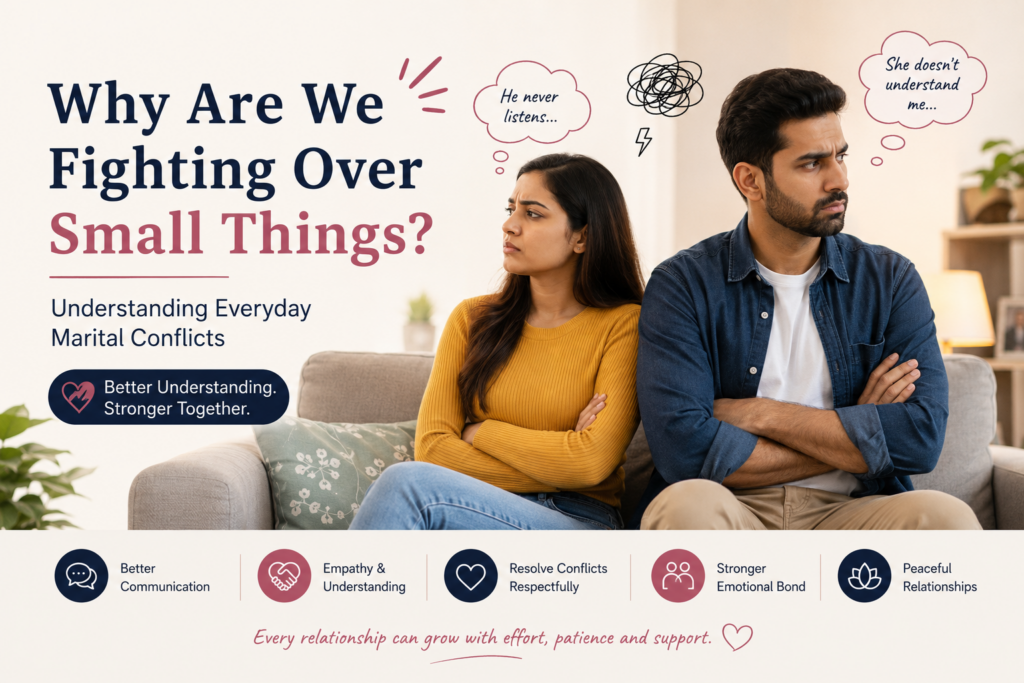
“He left the towel on the bed again.”
“She didn’t reply to my message all day.”
“Why can’t you just put your phone away during dinner?”
“You forgot to buy milk—again.”
At first glance, these seem like small issues. Yet, for many couples, these tiny moments turn into heated arguments, silent treatments, or days of emotional distance.
If you and your partner find yourselves fighting over seemingly insignificant things, you’re not alone. Thousands of Indian couples experience this every day. The truth is, most marital conflicts are not really about the towel, the dishes, or the forgotten grocery item. They are often symptoms of deeper emotional needs that are not being met.
Understanding why these conflicts happen is the first step towards building a healthier, happier relationship.
Think of marriage like a pressure cooker.
Everyday stress from work, finances, family responsibilities, parenting, health concerns, and social expectations slowly builds pressure. A tiny disagreement then becomes the whistle that releases all the built-up emotions.
The “small issue” is rarely the real issue.
Instead, the argument may actually be about:
Feeling unheard
Feeling unappreciated
Emotional loneliness
Lack of quality time
Stress from work
Financial worries
Unresolved past arguments
Expectations that were never communicated
Every marriage is different, but psychologists frequently see recurring patterns.
One partner may feel they are doing everything.
“I cook, clean, manage the children, and still nobody notices.”
The other partner may genuinely believe they are contributing equally.
Instead of discussing responsibilities calmly, resentment builds over months.
One of the most common complaints today is:
“You’re always on your phone.”
Sometimes it is not about the phone itself.
It is about wanting attention, connection, and emotional presence.
Even spending two hours scrolling through social media can make the other partner feel ignored.
Money remains one of the biggest reasons for marital disagreements in India.
Arguments may arise over:
Spending habits
Saving money
Loans
Supporting parents
Children’s education
Lifestyle expectations
Financial disagreements often reflect differences in values rather than simply numbers.
Indian marriages usually involve two families—not just two individuals.
Conflicts may occur when:
Parents interfere in decisions.
One partner feels unsupported.
Boundaries are unclear.
Expectations from both families differ.
Without healthy communication, these situations quickly become emotionally exhausting.
Should children have screen time?
Which school should they attend?
Who is too strict?
Who is too lenient?
Different parenting styles can create daily disagreements, especially when both partners are already under stress.
Many couples spend years living together without truly connecting.
Busy schedules often revolve around:
Office work
Children
Household chores
Extended family
Social commitments
Conversations become limited to logistics instead of emotions.
Psychologists often encourage couples to look beyond the words being spoken.
For example:
Instead of hearing:
“You never help me.”
The underlying message may be:
“I feel alone.”
Instead of:
“You’re always late.”
The real emotion could be:
“I don’t feel important to you.”
Understanding emotions rather than reacting to words can transform how couples communicate.
The early phase of marriage usually involves excitement and novelty.
As years pass, responsibilities increase:
Career growth
EMI payments
Raising children
Caring for ageing parents
Health concerns
Stress gradually replaces romance.
Partners often stop expressing appreciation because they assume the other person already knows how they feel.
Unfortunately, emotional neglect often begins quietly.
Healthy communication does not mean never arguing.
It means arguing respectfully.
Instead of saying:
“You always do this.”
Try saying:
“I felt hurt when this happened.”
Instead of blaming, focus on expressing feelings.
Using “I” statements instead of “You” statements reduces defensiveness and encourages understanding.
Many relationships don’t break because of one major event.
They weaken because of repeated unhealthy habits such as:
Constant criticism
Sarcasm
Interrupting
Bringing up old mistakes
Avoiding conversations
Silent treatment
Comparing your spouse with others
Taking each other for granted
These behaviours slowly reduce trust and emotional safety.
Occasional disagreements are normal.
However, professional help may be beneficial if you notice:
The same arguments repeating every week.
Conversations ending in shouting.
Long periods of silence after disagreements.
Feeling emotionally disconnected.
Avoiding each other at home.
Loss of respect.
Constant blame.
Increased anxiety before talking to your partner.
Thoughts about separation because communication feels impossible.
Recognising these signs early can prevent deeper relationship distress.
Avoid preparing your response while your partner is speaking.
Instead, genuinely try to understand what they are feeling.
Simple words like:
“Thank you.”
“I appreciate your help.”
“I’m proud of you.”
can strengthen emotional connection.
Even 20–30 minutes without phones can improve communication.
Go for a walk.
Have tea together.
Talk about your day.
Small moments create emotional closeness.
If emotions are overwhelming, take a short break.
Return to the conversation after calming down.
The goal is solving the problem—not winning the argument.
Healthy marriages are partnerships, not competitions.
Avoid mentally counting who did more.
Instead, focus on teamwork.
No two people think exactly alike.
Different opinions do not mean incompatibility.
Acceptance often reduces unnecessary conflict.
Many couples hesitate to seek counselling because they believe:
“People will judge us.”
“Our marriage isn’t that bad.”
“Counselling is only for couples planning divorce.”
These are common myths.
Marital counselling is not about deciding who is right or wrong.
It is about helping couples:
Communicate effectively
Understand emotional needs
Resolve conflicts respectfully
Improve trust
Strengthen emotional intimacy
Learn healthier relationship patterns
Seeking help early is often easier than trying to repair years of accumulated hurt.
During counselling, both partners are encouraged to share their experiences in a safe, neutral, and confidential environment.
A psychologist or mental health professional helps couples:
Identify unhealthy communication patterns
Understand recurring conflicts
Learn practical conflict-resolution skills
Improve emotional connection
Develop realistic expectations
Build mutual respect and empathy
Counselling is a collaborative process—not a place for blame.
Consider speaking to a mental health professional if:
Every conversation turns into an argument.
You feel emotionally distant despite living together.
Trust has weakened.
Stress is affecting your relationship.
Conflicts are becoming frequent and intense.
You struggle to resolve disagreements on your own.
The earlier couples seek support, the easier it is to rebuild healthy communication.
Every marriage experiences disagreements. Fighting over small things does not automatically mean your relationship is failing.
Often, these arguments are simply signals that one or both partners are feeling overwhelmed, unheard, or emotionally disconnected.
The good news is that relationships can improve when both partners are willing to understand each other, communicate openly, and seek support when needed.
Marriage is not about finding a perfect partner. It is about learning, growing, and navigating life’s challenges together with compassion, patience, and mutual respect.
If everyday conflicts are affecting your peace of mind or the quality of your relationship, remember that seeking help is a sign of strength—not failure. With the right guidance and effort, many couples rediscover connection, rebuild trust, and create a healthier, more fulfilling marriage.