
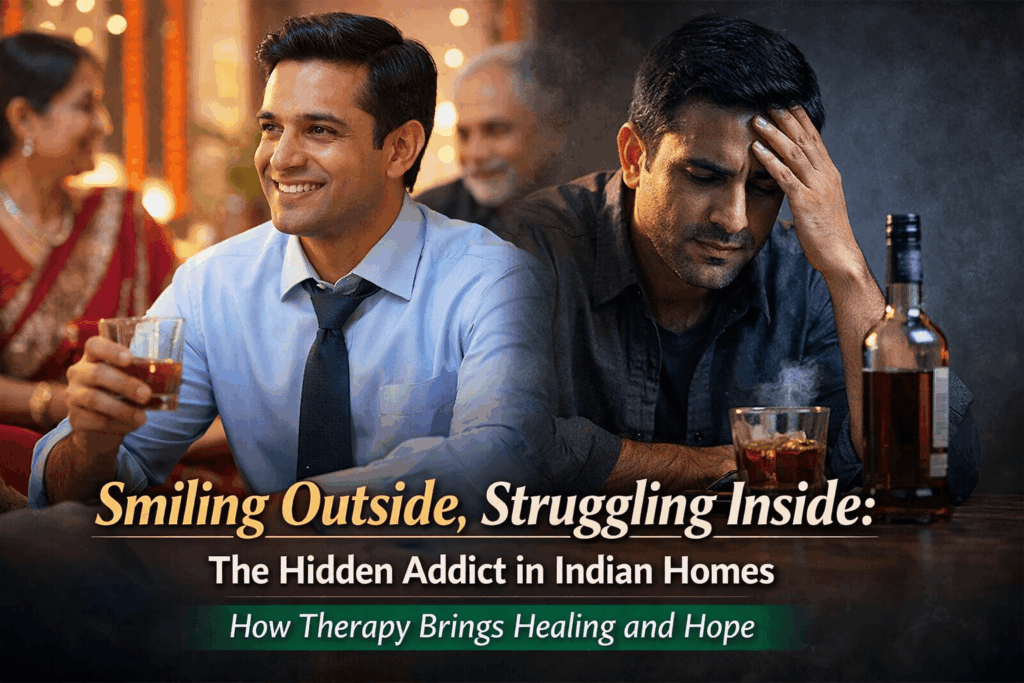
In many Indian homes, everything appears normal on the surface. The family attends weddings together, celebrates festivals, maintains social respectability, and upholds tradition. The son is doing well in his job. The father is responsible. The mother manages everything silently. Smiles are present in photographs.
But behind closed doors, someone in that home may be struggling deeply.
Addiction in India often hides in plain sight. It does not always look like a dramatic collapse. Sometimes it looks like a functioning professional, a caring parent, or a responsible student who is quietly losing control. The person may appear strong, confident, and composed outside — but inside, they are battling cravings, guilt, shame, and emotional exhaustion.
This is the story of the “hidden addict” in Indian homes — and how therapy can bring real healing and hope.
Addiction is often misunderstood as a lack of willpower or a moral weakness. In reality, modern psychology — supported globally by organizations like the World Health Organization — recognizes addiction as a complex mental health condition involving brain chemistry, emotional regulation, and behavioral patterns.
In India, however, addiction frequently remains hidden due to:
Social stigma
Fear of “log kya kahenge?”
Family reputation concerns
Denial within the household
Limited mental health awareness
As a result, many individuals continue functioning outwardly while deteriorating internally.
The hidden addict may be:
A corporate employee who drinks every night to manage stress
A businessman dependent on tobacco or alcohol to cope with pressure
A college student using substances to escape academic anxiety
A homemaker secretly misusing prescription medication
A teenager addicted to gaming or online betting
They may not miss work. They may not create public drama. But their inner world is slowly shrinking around the substance or behavior.
Addiction becomes a private coping mechanism — a way to manage stress, loneliness, emotional neglect, trauma, or overwhelming expectations.
Many Indians grow up hearing:
“Be strong.”
“Don’t talk about family problems outside.”
“Control yourself.”
Emotional vulnerability is rarely encouraged. Especially for men, expressing sadness, fear, or anxiety may be seen as weakness. Substances then become an easier outlet than emotional expression.
Academic pressure, career competition, financial responsibilities, and family obligations create chronic stress. Without healthy coping tools, individuals turn to quick relief — alcohol, nicotine, drugs, gambling, or digital distractions.
Over time, relief becomes dependence.
Sometimes families know something is wrong — but they avoid addressing it.
“It’s just social drinking.”
“All boys experiment.”
“He works hard; let him relax.”
Denial delays intervention. And addiction strengthens in silence.
Behind the smile, there is often:
Persistent guilt
Fear of being exposed
Self-blame
Anxiety
Irritability
Sleep disturbances
Secret financial strain
Many hidden addicts promise themselves daily: “This is the last time.”
But addiction is not controlled by promises alone. It involves changes in brain reward circuits, impulse control, and stress response. Without structured support, quitting becomes extremely difficult.
Because the person appears functional, the signs are subtle:
Increased irritability or anger
Social withdrawal
Defensive behavior when questioned
Secretive financial transactions
Sleep pattern changes
Mood swings
Loss of interest in hobbies
Frequent “need to relax” statements
Recognizing these early signs can prevent long-term damage.
Addiction is rarely just about the substance. It is often about:
Unprocessed trauma
Chronic stress
Low self-worth
Emotional neglect
Relationship conflicts
Performance anxiety
Loneliness within a crowded home
Substances temporarily numb emotional pain. But they do not solve it. Therapy addresses the root — not just the symptom.
The good news is this: addiction is treatable. Recovery is possible. And therapy offers structured, evidence-based support that goes beyond willpower.
The first step in therapy is creating a confidential, non-judgmental space.
Many individuals hesitate because they fear being labeled. But professional therapy ensures privacy, dignity, and empathy. Speaking openly about struggles often reduces shame immediately.
For many patients, simply being heard without criticism is deeply healing.
Therapists help identify:
Emotional triggers (stress, loneliness, anger)
Environmental triggers (work stress, peer group)
Relationship triggers
Internal thoughts (“I can’t cope without it”)
When triggers become clear, they become manageable.
One of the most effective approaches in addiction recovery is Cognitive Behavioral Therapy (CBT). CBT helps individuals:
Identify negative thinking patterns
Challenge irrational beliefs
Develop healthier coping mechanisms
Replace addictive behaviors with constructive habits
Instead of reacting automatically to stress, patients learn to respond consciously.
Many hidden addicts lack healthy tools for handling emotions.
Therapy teaches:
Stress management techniques
Breathing and grounding exercises
Mindfulness practices
Anger regulation strategies
Communication skills
When emotional resilience improves, the need for substances reduces.
Recovery is not just about quitting — it’s about staying stable long term.
Therapists help create:
High-risk situation plans
Emergency coping strategies
Support systems
Lifestyle restructuring
Relapse, if it happens, is treated as a learning opportunity — not failure.
In Indian households, family dynamics play a major role.
Therapy may include:
Psychoeducation for family members
Boundary setting
Communication repair
Reducing enabling behaviors
Rebuilding trust gradually
Healing becomes collective, not isolated.
Professional therapy maintains strict confidentiality.
Some people can reduce habits independently. But when cravings, withdrawal, or repeated relapse occur, structured therapy significantly improves outcomes.
Seeking help requires courage. Recognizing a problem is strength.
Recovery is not instant. It typically includes:
Assessment and understanding addiction severity
Identifying emotional and behavioral patterns
Gradual reduction or cessation (sometimes with medical support)
Skill-building and emotional work
Long-term maintenance
Each person’s journey is unique. Therapy is personalized.
Thousands of individuals in India silently battle addiction. Many continue smiling outside while struggling inside.
But recovery stories are real.
People regain:
Emotional stability
Financial control
Relationship trust
Self-respect
Physical health
Career focus
Most importantly, they regain control over their own lives.
Consider professional support if:
Attempts to quit repeatedly fail
Substance use is increasing
Relationships are affected
There is secrecy or guilt
Work performance is declining
You feel emotionally dependent on the substance
Early intervention prevents deeper damage.
If you suspect a loved one is struggling:
Avoid accusation.
Avoid public confrontation.
Express concern calmly.
Encourage professional consultation.
Focus on support, not shame.
Addiction thrives in judgment. It weakens in compassion.
The hidden addict in Indian homes does not need criticism. They need understanding. They need structured support. They need hope.
Smiling outside while struggling inside is exhausting. But it does not have to continue.
Therapy offers:
Clarity
Emotional safety
Practical tools
Professional guidance
Sustainable recovery
Healing begins the moment silence is broken.
If you or someone in your family is silently battling addiction, remember: seeking help is not an act of weakness — it is the first act of courage toward a healthier, freer life.
Recovery is possible. And hope is stronger than addiction.