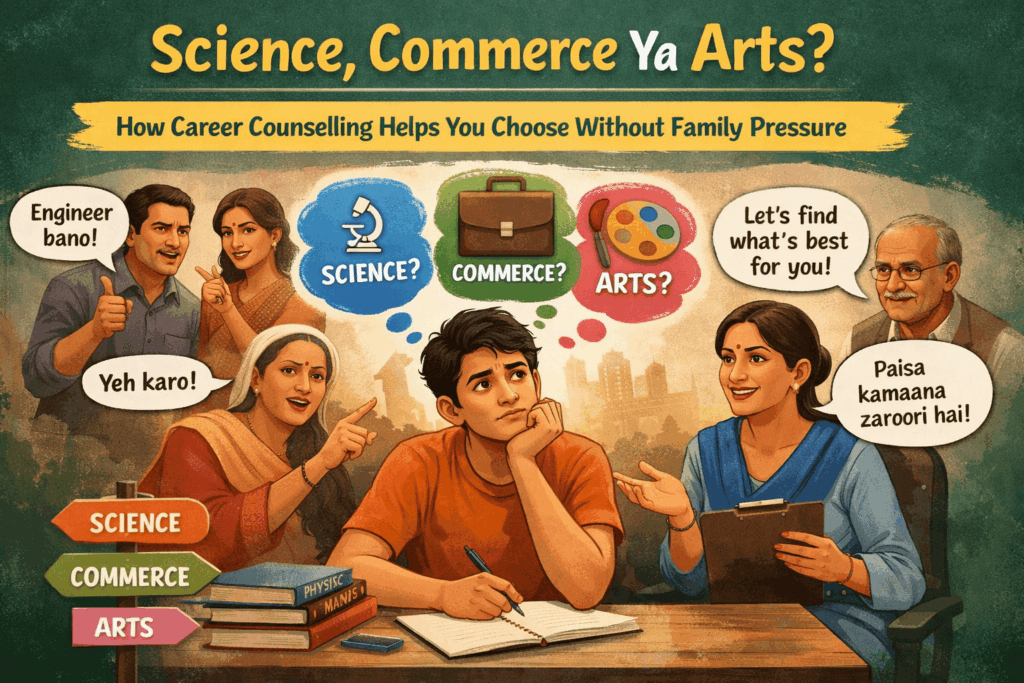
Every year, lakhs of Indian students finish their Class 10 board exams and face one of the biggest life decisions—which stream to choose next: Science, Commerce, or Arts. It’s a choice that can shape your higher studies, career opportunities, and even your happiness. But for many, this choice isn’t entirely theirs.
Parents, relatives, and societal expectations often weigh heavily on these young shoulders. “Beta, science le lo—doctor ya engineer ban jao,” or “Commerce theek rahega, business sambhal lena”—phrases every teenager has heard at least once. Yet, the truth is simple: career choices should align with one’s interests, personality, and aptitude—not merely with family expectations or social trends.
This is where career counselling steps in—not as a tool of rebellion, but as a bridge between passion and practicality.
When students leave school after Class 10, they are barely 15 or 16 years old. At that age, few truly know what they want from life. Yet, they are asked to pick a stream that may determine their college course, career track, and even social identity.
Three reasons make this transition so stressful:
Lack of self-awareness: Many students don’t yet know their aptitudes, strengths, or what careers align with them.
External pressure: Parents and peers often encourage “safe” streams linked to prestige or income rather than fit.
Fear of unknown: Students worry they’ll disappoint their families or end up with limited opportunities if they pick differently.
Ironically, the pressure to “choose right” often leads to choosing wrong—not because the field is bad, but because it’s not the student’s fit.
In India, family plays a powerful role in career decisions. Parents care deeply about their child’s future, but sometimes confuse security with suitability. A doctor’s child is expected to pursue medicine. A business family nudges toward commerce. A family that equates prestige with science often insists on it, irrespective of the child’s genuine calling.
But here’s what psychology tells us: career satisfaction arises when aptitude, interest, and values align with the chosen field. If a student is creatively gifted but forced into physics and chemistry, frustration and burnout are predictable outcomes.
Career counselling provides a neutral, evidence-based framework for students to understand themselves and their options. Rather than telling them what to do, it helps them discover what fits best. Think of counsellors as navigators who use psychological tools and real-world data to chart your personal map of success.
A professional career counsellor evaluates three main components:
Aptitude: your natural strengths in logical reasoning, language, creativity, numbers, or spatial skills.
Interest: what genuinely excites or motivates you across subjects and activities.
Personality: how you think, behave, and interact—for instance, are you analytical, practical, or expressive?
Standardized psychometric tests (like Holland’s Career Typology, MBTI, or aptitude batteries) help clarify this profile. The counsellor then matches it with fitting streams and real-world careers.
For example, a student high in verbal reasoning, curiosity, and empathy may thrive in Arts and social sciences; a number-minded, dynamic personality may prefer Commerce; a conceptual, problem-solving mind may enjoy Science.
This approach replaces guesswork and pressure with clarity and self-confidence.
Let’s decode the three main streams—without stereotypes or biases.
Science opens doors to medicine, engineering, research, biotechnology, IT, and data science. Students drawn to logic, patterns, and solving problems often find it fulfilling. However, it’s not just about high marks—it demands genuine curiosity, discipline, and perseverance.
Modern science is broad:
PCM (Physics, Chemistry, Math) leads to engineering, design, architecture, or pure sciences.
PCB (Physics, Chemistry, Biology) opens the path to medicine, psychology, forensic science, biomedicine, and more.
PCMB keeps all doors open, though it can be academically demanding.
Counsellors help students assess whether their learning style and motivation align with the rigor Science demands.
Commerce attracts those with practical intelligence and an eye for systems, markets, and money. Careers include finance, management, law, entrepreneurship, chartered accountancy, and even economics. Students who enjoy mathematics, problem-solving, and understanding how businesses work often thrive here.
Commerce is expanding rapidly, especially with digital marketing, business analytics, fintech, and startup ecosystems. It’s not “easier than science”—it’s simply different in structure and application.
Arts encourages critical thinking, creativity, and understanding human behavior and society. Fields like psychology, law, design, media, literature, civil services, and policy come under its umbrella. An art student with a good sense of research and communication can excel across diverse areas.
The stereotype that Arts is for “less serious students” is outdated. Today, professionals from humanities backgrounds lead in startups, journalism, UX design, and research institutes.
A good counsellor helps students and parents see such distinctions objectively—focusing on aptitude fit, not old hierarchies.
Many students say, “I want to take Arts, but my parents won’t agree.” Career counselling mediates this gap effectively because it offers scientific validation rather than mere opinions.
Here’s how counselling helps both sides:
Objective insights: Psychometric reports provide data that parents can trust.
Structured discussion: Counsellors act as mediators who explain choices calmly and with evidence.
Career mapping: Counsellors show real career trajectories, colleges, and future income prospects across streams, easing parents’ fears.
Reducing guilt and anxiety: When a decision is backed by data and understanding, both student and parent feel confident instead of conflicted.
For instance, when a psychometric report shows that a student has high artistic aptitude, strong verbal intelligence, and an outgoing personality, parents can better appreciate the logic behind choosing design or media studies over engineering.
Career counselling thus transforms a family argument into a family agreement.
From a mental health perspective, supporting adolescents in making autonomous choices is crucial. Research in developmental psychology shows that autonomy-supportive parenting fosters motivation, resilience, and long-term satisfaction. Conversely, controlling or coercive influences lead to anxiety, self-doubt, and lower achievement.
Career counselling empowers students to exercise autonomy—with guidance, not rebellion. It nurtures emotional maturity, helping them recognize that choosing independently doesn’t mean disrespecting their parents’ dreams—it means aligning both sets of aspirations through informed discussion.
“Science students are smarter.”
Intelligence is multi-dimensional. Creativity, emotional intelligence, and social reasoning are equally powerful predictors of success.
“Commerce is only for business-minded students.”
Modern commerce links to fields like law, actuarial science, sports management, and digital entrepreneurship—diverse, not narrow.
“Arts students don’t get jobs.”
Humanities graduates work across media, education, civil services, advertising, design, psychology, and policy analysis.
“Once a stream is chosen, you can’t change.”
Cross-disciplinary opportunities are plentiful today. Students can shift later with foundation programs or dual degrees.
Counselling helps students and parents see education as a flexible journey, not a rigid track.
Students and parents often wonder how the process works. A proper counselling program typically includes:
Initial interview: Understanding the student’s background, goals, and concerns.
Psychometric testing: Standardized aptitude, interest, and personality assessments.
Analysis and report: Data that reveal the student’s unique potential profile.
Guidance session: Counsellor explains suitable streams, subjects, and possible career clusters.
Parent session: To align expectations and outline viable future paths.
Follow-up: Some counselling centers track progress across Classes 11–12 and even during graduation.
In India, reputable platforms like Mindler, iDreamCareer, Careerguide, and The Lifestyle Clinic’s counselling programs use globally validated tests and expert panels for such assessments.
Let’s take Riya’s case. A bright student from Faridabad scored 88% in her Class 10 boards. Her father, an engineer, wanted her to take PCM to “keep all options open.” But Riya loved literature, art, and psychology. Their family tension was palpable.
During a comprehensive career counselling session, her psychometric analysis showed high verbal intelligence, exceptional creative reasoning, and strong interpersonal sensitivity. The counsellor explained how these traits could lead to flourishing careers in communication design, media psychology, or brand strategy—fields Riya’s father hadn’t considered.
Once they saw concrete data and real examples of successful professionals in those domains, her parents supported her Arts choice. Today, Riya is thriving as a design psychology student.
It wasn’t “against” her family—it was a well-informed, peaceful decision.
Parents also need support to manage anxiety about their child’s choices. Counselling sessions educate them about:
Emerging career landscapes: AI, design, behavioral sciences, and digital humanities are growing fast.
Changing job security trends: Skill adaptability now matters more than traditional degree hierarchies.
Non-linear careers: Many professionals today combine multiple domains—like engineers turned product designers, or psychologists in corporate roles.
When parents feel informed, they become allies in the child’s decision-making instead of roadblocks.
The old boundaries between Science, Commerce, and Arts are fading. New interdisciplinary careers reward creativity plus technical skills:
Data journalism mixes maths with media.
Behavioral economics blends psychology and commerce.
UX design blends technology with user empathy.
Neuro-marketing fuses neuroscience with business.
A skilled counsellor helps students explore such hybrid futures instead of boxing themselves into outdated streams.
Career counselling isn’t a one-time choice—it’s a lifelong skill. By learning how to explore interests and evaluate options, students build career adaptability—the ability to grow, pivot, and thrive in changing times.
In a future where AI, automation, and global shifts constantly reshape opportunities, this adaptability will matter much more than the initial stream itself.
Choosing between Science, Commerce, or Arts is not merely deciding what subjects to study; it’s choosing how you want to understand and engage with the world. And that decision must come from within—not from fear, comparison, or parental pressure.
Career counselling offers the scientific tools and emotional support to make this decision wisely—one that respects both the student’s individuality and the family’s hopes. It’s not about rejecting guidance, but about transforming it into mutual understanding.
As a psychiatrist and counsellor often tells students:
“Don’t choose a stream to impress others—choose one that expresses who you are.”
When the choice comes from clarity rather than compulsion, success follows naturally—and peace follows soon after.