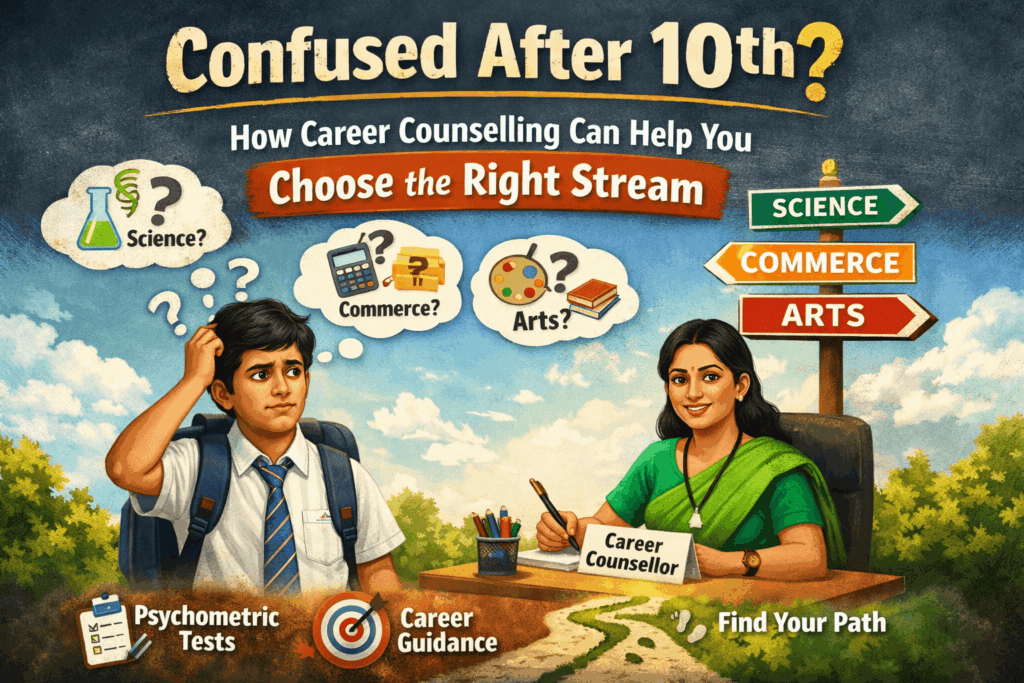
Choosing the right stream after Class 10 is one of the most important decisions in a student’s academic journey. For many students, this moment comes with excitement—but also a lot of confusion and pressure. Questions like “Should I take Science, Commerce, or Arts?”, “What career options will I have?”, and “What if I make the wrong choice?” often create stress for both students and parents.
In India, this decision is often influenced by family expectations, peer pressure, or common myths about certain streams. However, choosing a stream without understanding your interests, abilities, personality, and career goals can lead to dissatisfaction later in life.
This is where career counselling becomes extremely valuable. With the guidance of trained psychologists and career experts, students can make informed decisions that align with their strengths and aspirations.
In this blog, we will explore why students feel confused after 10th, the available streams, common mistakes students make, and how career counselling can help you choose the right path for your future.
The transition from Class 10 to Class 11 is a major turning point. Unlike earlier grades, students must now choose a stream that will shape their higher education and career options.
Several factors contribute to this confusion:
Today, students have access to hundreds of career paths—from engineering and medicine to digital marketing, psychology, entrepreneurship, and design. While this variety is exciting, it can also make decision-making difficult.
Many students are only aware of traditional careers such as doctor, engineer, or lawyer. However, modern careers in fields like data science, artificial intelligence, sports management, and UX design are rarely discussed in schools.
Students often choose a stream because their friends are choosing it or because their family expects them to follow a certain career path.
Many students worry that selecting the wrong stream will limit their career options in the future.
At the age of 15–16, many students are still discovering their strengths, interests, and personality traits.
Career counselling helps solve all these problems by providing clarity, awareness, and structured guidance.
Before making a decision, it is important to understand what each stream offers.
Science is often considered the most popular stream because it opens doors to many professional careers.
Physics
Chemistry
Biology (for medical students)
Mathematics (for engineering students)
Computer Science
Students who choose science can pursue careers such as:
Doctor
Engineer
Scientist
Pharmacist
Architect
Data Scientist
Pilot
Science provides flexibility because students can later shift to other fields like management, law, or finance.
However, it also requires strong analytical skills, interest in problem-solving, and dedication to rigorous study.
Commerce is ideal for students interested in business, finance, economics, and management.
Accountancy
Business Studies
Economics
Mathematics (optional in some schools)
Commerce students can pursue careers such as:
Chartered Accountant (CA)
Company Secretary (CS)
Business Analyst
Investment Banker
Entrepreneur
Financial Planner
Marketing Professional
Commerce is an excellent option for students who enjoy numbers, business concepts, and strategic thinking.
The Arts stream is often misunderstood but offers some of the most diverse career opportunities.
Psychology
Political Science
Sociology
History
Geography
English Literature
Students from the Arts stream can pursue careers such as:
Psychologist
Journalist
Lawyer
Civil Services Officer
Graphic Designer
Social Worker
Content Creator
With the rise of creative industries and social sciences, the Arts stream has become increasingly valuable.
Many students make decisions that they later regret. Here are some common mistakes:
Students often select the same stream as their friends to stay together, ignoring their own interests.
Some families encourage students to choose careers like medicine or engineering without considering the student’s passion.
For example, many people believe that Science is the best stream or that Arts has fewer career options, which is not true.
Choosing a stream that does not match your interests can lead to poor performance and low motivation.
Students rarely explore the full range of careers available in each stream.
Career counselling helps prevent these mistakes by offering scientific and personalized guidance.
Career counselling is a professional process that helps students understand their strengths, interests, personality, and abilities to choose the right career path.
Career counsellors often use psychometric assessments, aptitude tests, and personality analysis to guide students toward suitable career options.
The goal of career counselling is to help students make confident and informed decisions about their future.
Career counselling helps students discover what they are naturally good at and what subjects they enjoy studying.
For example:
Students who enjoy problem-solving may excel in science or technology.
Students who enjoy communication and creativity may thrive in arts or media.
Understanding these strengths helps students choose a stream that aligns with their abilities.
Psychometric tests analyze various aspects of a student’s personality and abilities, such as:
Aptitude
Interest areas
Personality traits
Learning style
These tests provide detailed reports that help counsellors recommend the most suitable career options.
Career counsellors introduce students to modern career options that they may not know about.
For example:
Artificial Intelligence
Digital Marketing
Game Design
Sports Psychology
Environmental Science
This exposure helps students explore careers beyond traditional choices.
Many students feel overwhelmed when choosing a stream. Career counselling provides clarity and reduces anxiety by offering structured guidance.
Students feel more confident when their decision is based on data, analysis, and expert advice.
Career counselling also helps parents understand their child’s abilities and interests.
When parents see professional assessments and reports, they are more likely to support their child’s career choices.
Making the right decision after 10th offers several long-term benefits.
Students perform better in subjects they enjoy and understand.
When students study subjects aligned with their interests, they remain motivated and engaged.
Choosing the right stream helps students plan their future education and career goals more effectively.
Many professionals regret choosing careers that do not match their interests. Career counselling helps prevent this.
Here are some practical tips to help students make the right decision:
Understand your strengths, weaknesses, and interests.
Research different careers before making a decision.
Your career path should be based on your abilities, not others’ choices.
Consult teachers, mentors, and career counsellors for guidance.
Scientific assessments can provide valuable insights about your career suitability.
Students should consider career counselling if they:
Feel confused about choosing a stream
Are unsure about their career goals
Feel pressure from family or peers
Want to explore career options in detail
Want expert guidance based on scientific assessment
Seeking career counselling early can save years of confusion and help students build a successful future.
Choosing the right stream after Class 10 is a critical step that can shape your academic journey and career path. While the decision may feel overwhelming, students do not have to face it alone.
With the help of professional career counselling, psychometric assessments, and expert guidance, students can gain clarity about their strengths and interests. This allows them to select a stream that aligns with their personality, abilities, and long-term goals.
Remember, there is no “best” stream—only the stream that is best for you.
If you or your child is feeling confused after 10th, seeking career counselling from a qualified psychologist can provide the guidance needed to make a confident and informed decision.
Your future is too important to leave to guesswork. The right guidance today can lead to the right career tomorrow.